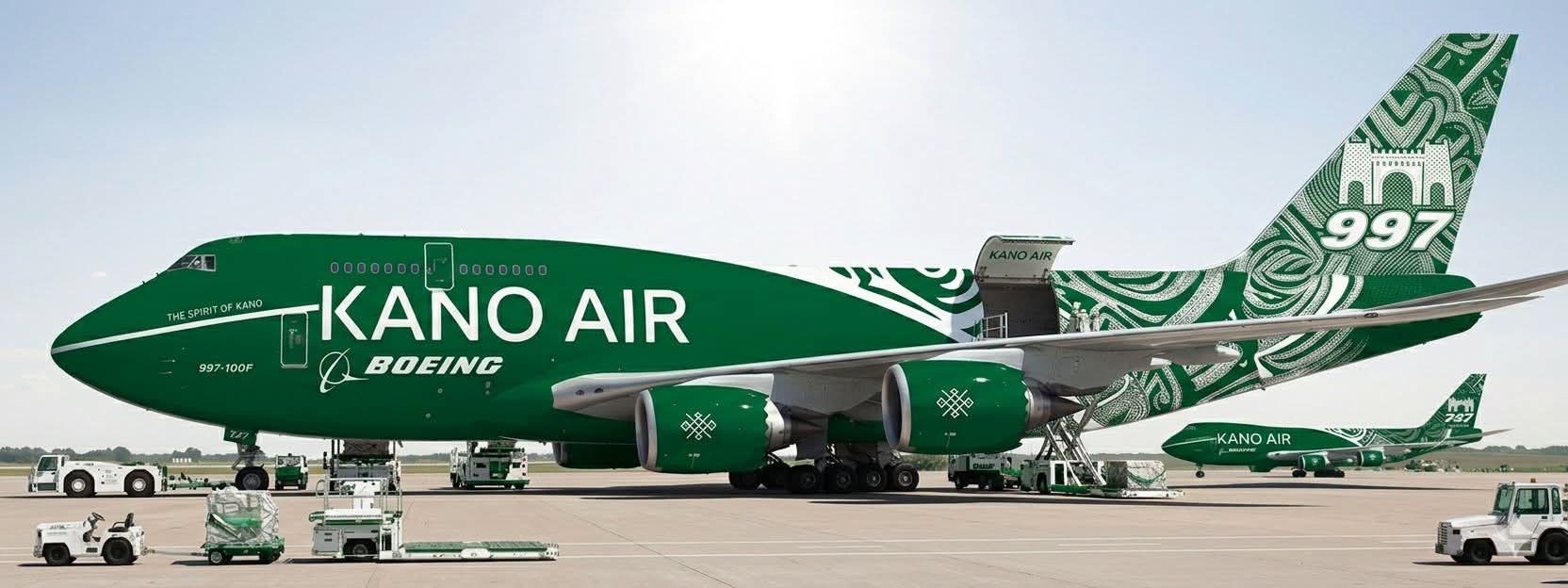
The discourse surrounding the Kano State Government’s visionary plan to establish a state owned commercial airline has recently been punctuated by skepticism. Critics, often viewing the sector through the narrow lens of existing private operators, argue that the market is already crowded.
This perspective is fundamentally flawed; it ignores the essential role of aviation as a strategic utility in the modern global economy. It is time to move beyond the status quo and recognize that for a commercial giant like Kano, a state with an estimated 2026 population exceeding 17.5 million, an indigenous airline is not merely an option; it is an economic imperative.
To understand the feasibility and necessity of this project, one must look at the objective data. Kano’s demographic scale is comparable to, and in many cases greater than, sovereign nations that have successfully utilized national carriers to anchor their regional influence.
It is a misconception that population size is the primary barrier to entry; rather, it is visionary governance and strategic integration.
Nations such as Qatar, Oman, and even smaller entities like Iceland and Mauritius, have leveraged aviation as a core component of their national identity and economic security.
If nations with a fraction of Kano’s demographic weight can dominate the skies, our ambition is not only grounded in reality but is a long overdue step toward our rightful role as a commercial powerhouse.
The most myopic aspect of current criticism is the failure to recognize aviation’s critical role in modernizing our agricultural sector and logistics backbone.
Kano is an agricultural heartland, yet we lose significant percentages of our high value produce to post harvest spoilage due to current logistical bottlenecks.
A state owned airline provides the missing link in a robust cold chain network. By integrating dedicated air cargo capacity, we transition from being a state that produces primarily for local consumption to one that delivers premium, farm fresh produce to international markets and regional hubs at peak quality.
Relying exclusively on road transport for perishables is economically inefficient; an indigenous airline allows us to control the speed of trade, ensuring Kano’s output reaches markets while still commanding premium prices.
By connecting our industrial and agricultural output directly to global air cargo corridors, we transform Kano into the primary logistics gateway for Northern Nigeria.
The advantages of this venture extend far beyond mere prestige; it is a multidimensional economic engine.
Beyond the specialized roles for pilots and engineers, the airline triggers a multiplier effect in ground handling, catering, specialized security, and administrative services, while simultaneously fostering a new generation of skilled youth.
Furthermore, it acts as a catalyst for the Mallam Aminu Kano International Airport, transforming it from a transit point into a vibrant operational hub that attracts foreign direct investment.
For a commercial nerve center like Kano, reliable and affordable air connectivity is a public utility.
By facilitating the rapid movement of business people and goods, we effectively lower the overhead for every enterprise in the state, fostering economic cohesion that private operators, driven by profit density alone, have failed to provide.
We are not approaching this from a position of inexperience. Since 2012, Kano State has systematically invested in its human capital, sponsoring the training of its indigenes in specialized aviation disciplines.
Today, the state possesses a latent reserve of internationally certified professionals who are the bedrock upon which our aviation future will be built.
To ensure the success of this vision, implementation must be disciplined.
The airline should be managed as a strictly commercial, limited liability entity, insulated from political interference and governed by a board of subject matter experts.
By adopting a Public Private Partnership model, the state can leverage private sector efficiency and technical proficiency while providing the necessary foundational support, mitigating capital risk and ensuring the airline remains a profitable asset rather than a fiscal burden.
The establishment of a Kano State owned airline is an act of creation. It is about expanding the total aviation ecosystem of the North, lowering the costs of transit, and providing the infrastructure our industrial base demands.
By moving forward, His Excellency the Governor is building a legacy of sovereignty, economic resilience, and progress. This project transcends political affiliation; it is a project for the people of Kano.
We appeal to all stakeholders to view this initiative as a shared inheritance and a mechanism for prosperity.
We invite existing operators to view the state owned carrier as a partner in growth—one that will expand the aviation pie for everyone.
It is time for Kano to take its rightful place in the skies, ensuring that our commercial potential is fully realized and that our logistical destiny is determined right here, at home.
Hon. Muhammad Sanusi Said Kiru, FCIA, Majidadin Kiru, writes from Kiru Local Government in Kano State.