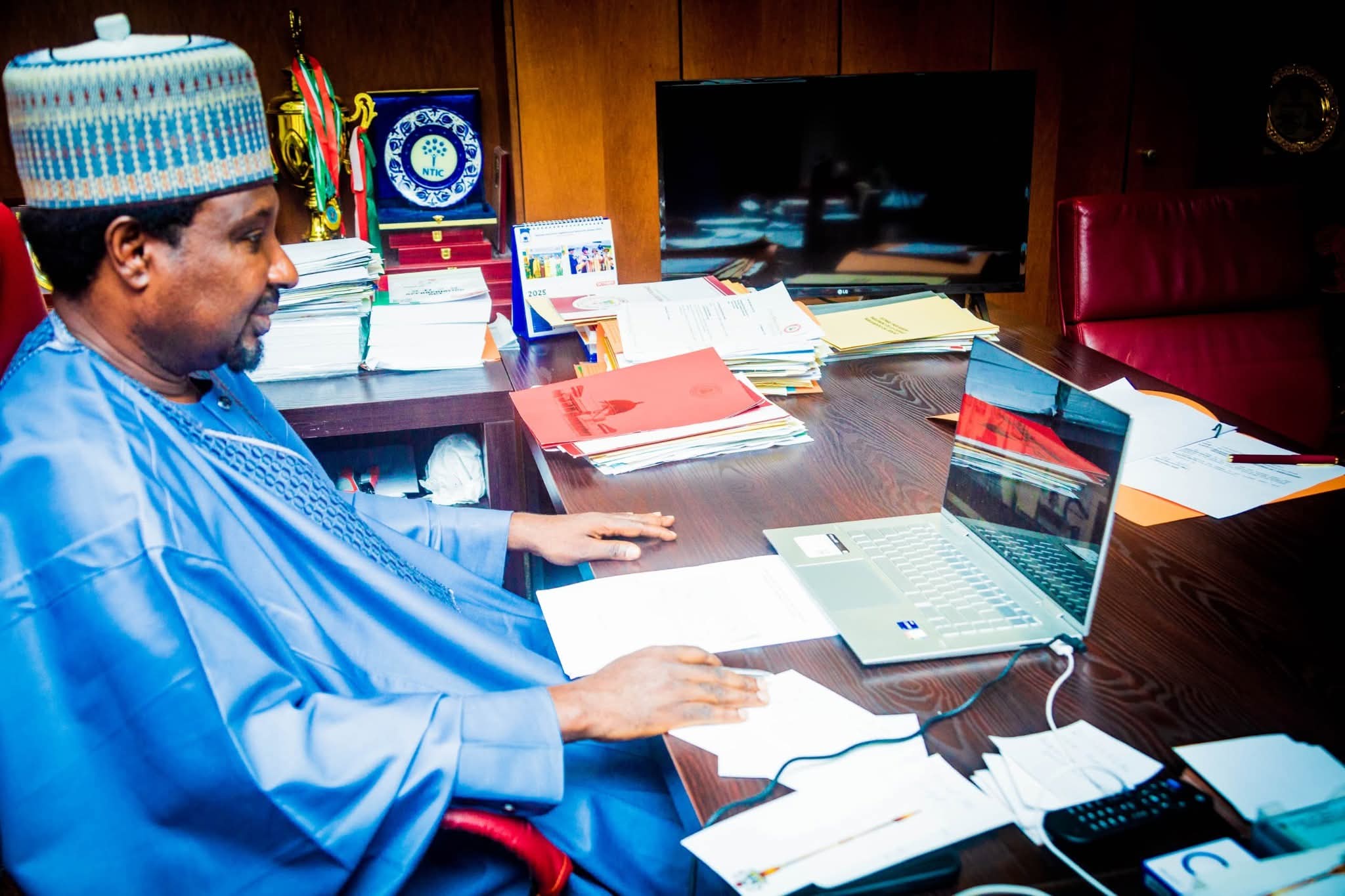
The Deputy President of the Senate, Senator Barau Jibrin, has delivered a lecture organised by the Department of Political Science, Faculty of Social Sciences, University of Ilorin, Nigeria, themed, ” The role of Legislature in Strengthening Democratic Governance in Nigeria.
The Independent Mirror reports that, Senator Barau Jibrin, In his verified Facebook account said “A moment ago, I delivered the Distinguished Personality Lecture organised by the Department of Political Science, Faculty of Social Sciences, University of Ilorin, Nigeria, themed, ” The role of Legislature in Strengthening Democratic Governance in Nigeria.
The highlight of the lecture, which I delivered virtually, was a question-and-answer session that provided the lecturers, students, and the entire university community with an opportunity to ask me questions about the legislature and the lawmaking process.
I thanked the institution for finding me worthy of delivering the lecture, allowing me to connect and relate with the university community.
Below is the paper I presented:
1.0 Introduction
Democratic governance thrives when public institutions operate transparently, uphold the rule of law, and remain accountable to the citizens. Among these institutions, the legislature stands out as the principal organ representing the will of the people. It is the platform through which citizens’ preferences are translated into laws and public policy, and it functions as a safeguard against the excesses of executive power (Lijphart, 2012).
In Nigeria, the legislature occupies a strategic position in the country’s democratic journey. Since the return to civilian rule in 1999, legislative institutions at both federal and state levels have undergone significant evolution, playing crucial roles in stabilizing the political system, advancing governance reforms, and promoting national development.
This paper examines the role of the legislature in strengthening democratic governance, drawing attention to its constitutional mandate, institutional capacity, democratic significance, and the emerging challenges and opportunities in consolidating Nigeria’s democratic experience. The aim is to highlight why a robust, credible, and people centred legislature remains indispensable to Nigeria’s democratic development.
2.0 Conceptual Clarifications
2.1 The Legislature
The legislature is the arm of government charged with the responsibility of lawmaking, oversight, and representation. Legislature is the platform where public views are debated, contested, and transformed into law (Norton, 2013). In presidential democracies such as Nigeria’s, the legislature also acts as a co-equal branch of government, constitutionally empowered to check the executive.
2.2 Democratic Governance
Democratic governance refers to the processes, institutions, and norms that ensure citizens participate meaningfully in public affairs, and that governments operate with transparency, accountability, and responsiveness (Hyden, 2013). Strengthening democratic governance therefore involves fortifying these institutions and norms so they become resilient, inclusive, and trusted by the public.
3.0 Constitutional Mandate of the Nigerian Legislature
The Constitution of the Federal Republic of Nigeria, 1999 (as Altered) confers extensive powers on the National Assembly and State Houses of Assembly. These powers include law-making (Sections 4 & 58), oversight of the executive (Sections 88 & 89), approval of budget and financial control, representation of the populace, and confirmation of executive appointments.
More so, through these powers, the legislature facilitates institutionalization democratic norms, prevents unilateral rule, and promotes public accountability.
4.0 The Role of the Legislature in Strengthening Democratic Governance
4.1 Law-Making and Institutional Consolidation
Lawmaking is one of the major responsibilities of the legislature.
Effective laws create the frameworks within which democratic institutions operate. In Nigeria, legislative actions have resulted in critical reforms such as enactment of the Nigeria Tax Act 2025, Nigeria Tax Administration Act 2025, Nigeria Revenue Service Act 2025, Joint Revenue Board Act 2025, and Electoral Act 2022.
It is significant to note that legislative enactments have far-reaching implications for democratic governance, especially when they promote transparency, clarify institutional mandates, and expand civic freedoms (Odalonu, 2020).
4.2 Oversight and Accountability
Legislative oversight is central to strengthening good governance. Oversight prevents abuse of power, deters corruption, and ensures compliance with budgetary and policy directives. The legislature serves as a watchdog through investigative hearings, reports of the Public Accounts Committees, and monitoring of Ministries, Departments, and Agencies (MDAs).
Similarly, legislative oversight reduces corruption, strengthens public financial management, and enhances democratic consolidation. Oversight functions such as budget performance reviews, probing of misappropriation, and scrutiny of public procurement processes directly contribute to improved governance (Yusuf, Friday & Joseph, 2022).
4.3 Representation and Citizen Engagement
Representation is the soul of democracy. It is one of the major responsibilities of legislators to articulate the interests of their constituents in lawmaking process. Through constituency offices, town halls meetings, petitions, and committee hearings, the legislature provides avenues for inclusive governance.
Moreover, representation enhances legitimacy and responsiveness in consolidating democratic governance in Nigeria. This is because when citizens are engaged, trust in public institutions increases, and democratic stability is strengthened.
4.4 Budgetary Powers and Public Finance Governance
The power of appropriation gives the legislature significant influence over national priorities. Parliament reviews revenue frameworks, scrutinizes expenditures, and ensures funds are allocated to areas of national interest.
It is important to note that legislative control over public finance management prevents mismanagement funds and ensure implementation of budget is in line with development goals. Through the budget process, the legislature influences economic governance and social welfare outcomes.
4.5 Electoral Reforms and the Protection of Democracy
The legislature is key to electoral reforms that improve election credibility in Nigeria. Amendments to the Electoral Act, particularly those introducing technological innovations, have strengthened transparency and reduced manipulation in electoral process.
Diamond (2019) stresses that credible elections are essential for democratic stability. Thus, legislative reforms that improve the integrity of elections significantly contribute to strengthening governance.
4.6 Upholding Checks and Balances
The doctrine of separation of powers which is predicated on the provisions of Sections 4, 5 and 6 of the Constitution of the Federal Republic of Nigeria, 1999 (as Altered) underpins Nigeria’s presidential system. The legislature checks executive dominance through oversight, confirmation of appointments, domestication of treaties, and parliamentary inquiries
Lijphart (2012) notes that checks and balances are indispensable for preventing authoritarian tendencies. Thus, a strong legislature ensures no branch of government becomes overwhelming.
5.0 Strengthening Legislative Capacity for Democratic Governance
5.1 Enhancing Institutional Autonomy
Financial independence, reforms of standing orders, and improved committee systems will bolster legislative independence.
5.2 Building Research and Technical Capacity
Investments in legislative research services, policy analysis units, and training programs will improve law-making and oversight quality.
5.3 Promoting Transparency and Open Parliament Reforms
Live streaming of hearings, open budget tracking, publication of committee reports, and citizen-accessible legislative databases can rebuild trust.
5.4 Strengthening Ethical Standards
A more effective code of conduct, enforcement mechanisms, and internal disciplinary procedures will enhance integrity.
5.5 Deepening Civic Engagement
Partnerships with civil society, academia, the media, and community organizations can strengthen citizen participation in legislative processes.
5.6 Advancing Electoral and Constitutional Reforms
Future reforms should focus on strengthening political parties, enhancing local government autonomy, protecting legislative independence and improving electoral technology. Such reforms will contribute significantly to institutionalization of democratic governance in Nigeria.
6.0 Conclusion
The legislature remains one of the major organs of Nigeria’s democratic system. Through lawmaking, oversight, representation, and budgetary powers, it plays a central role in strengthening democratic governance. While substantial progress has been made since 1999, few notable challenges continue to hamper effectiveness.
Strengthening democratic governance in Nigeria depends on sustaining and deepening legislative reforms. A strong, independent, transparent, and accountable legislature is not just a constitutional requirement; it is essential for the survival and flourishing of democracy. Nigeria’s democratic future will ultimately be shaped by the quality, integrity, and effectiveness of its legislative institutions.
References
Yusuf, Y. A., Friday, J., & Joseph, O. F. (2022).
Legislative oversight and democratic consolidation in Nigeria: 1999–2019.
African Social Science and Humanities Journal, 3(2), 57–68. https://doi.org/10.57040/asshj.v3i2.170
Diamond, L. (2019). Ill winds: Saving democracy from Russian rage, Chinese ambition, and American complacency. Penguin Press.
Odalonu, H. B. (2020). The role of legislature in promoting good governance in Nigeria. Studies in social sciences and humanities, 140-160.
Federal Republic of Nigeria. (1999). Constitution of the Federal Republic of Nigeria (as amended). Government Press.
Hyden, G. (2013). Governance and development. World Bank.
Lijphart, A. (2012). Patterns of democracy: Government forms and performance in thirty-six countries (2nd ed.). Yale University Press.
Norton, P. (2013). Parliaments and governments in Western Europe. Frank Cass.
Pitkin, H. (1967). The concept of representation. University of California Press.